Why turn your idea into a SaaS?
The SaaS model (Software as a Service) has become the default way to monetise a digital product. Not because it is fashionable, but because the economics underneath it are fundamentally better than those of software sold once or a service billed by the day.
But building a SaaS is different from building a website or an internal application. The technical decisions taken in the first few weeks have consequences you pay for years later. Here is what we have learned supporting SaaS founders since 2021.
What does recurring revenue give you over a service model?
Compare two businesses at the same annual revenue.
Service model: you invoice projects. Every month you start again from zero. If you fall ill, take a holiday, or lose a large client, revenue drops. A service business is typically valued between 0.5× and 1× annual revenue.
SaaS model: your customers pay a monthly or annual subscription. This month's revenue is known before the month starts. Customers who renew automatically form a stable base. A SaaS with good retention is typically valued between 3× and 10× annual recurring revenue (ARR).
That is not a detail: it is the difference between a business that lives month to month and a company that compounds over time.
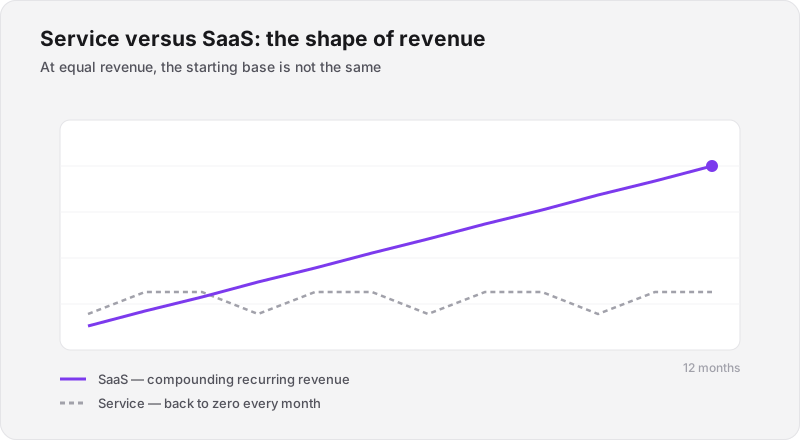
A service starts over every month. A SaaS starts from where it ended last month.
Why does a SaaS scale better than a service?
In a service model, your revenue is capped by your time. To double revenue you roughly have to double the team — with all the management complexity that brings.
In a well-designed SaaS, your marginal cost per customer tends towards zero as you grow. Once the infrastructure is in place, going from 100 to 1,000 customers does not require ten times the team. Infrastructure adapts (horizontal scaling), support organises itself (knowledge base, chatbot, ticketing), and the code serves everyone at once.
This is the scale effect: each new customer costs less to serve than the last, and every product improvement benefits all your customers simultaneously.
Which kinds of ideas turn into good SaaS products?
Not every idea suits SaaS. Here are the criteria that make a problem a good fit:
Recurring need. Accounting software, a project management tool, an HR platform: the need exists every month, every week, sometimes every day. A customer who uses the product once a year will be hard to retain.
Measurable gain. Customers stay subscribed when the product visibly saves them time or money. A tool that automates a task which used to take 2 hours a week easily justifies its subscription.
Specific pain. The best SaaS products address a precise pain in a precise sector. “Software for Moroccan real-estate agencies” is more defensible than “management software”. Specificity lets you build something genuinely fitting and earn a reputation in a niche.
Accumulated data. If your product accumulates data for the customer (history, analytics, created content), the cost of leaving for a competitor rises over time. That is lock-in through value — the healthiest form of retention.
Where to start: why is an MVP essential?
The most expensive mistake when building a SaaS: spending 18 months building a complete product before showing it to a single real user.
The MVP (Minimum Viable Product) is not a degraded version of your product. It is the simplest version that tests your central business hypothesis: do people really have this problem? Will they pay to solve it?
We structure our SaaS projects around that question: which single feature creates the most value for your first users? That is the only thing we build first. Everything else — advanced dashboards, integrations, reporting — comes afterwards, once real users have confirmed they need it.
In practice, a well-scoped SaaS MVP can ship in 8 to 14 weeks. That is enough to start acquiring users, gathering feedback and raising funds if needed.
Which technical foundations should a SaaS plan for?
The architectural decisions taken at the start are the hardest to undo later. These have the most impact.
Multi-tenant architecture. How do you isolate one customer's data from another's? Two main approaches: a shared database with isolation by tenant_id, or one database per customer. The first is cheaper but harder to secure. The second is more robust but costs more in infrastructure. The choice depends on data sensitivity and the compliance requirements of your market.
Authentication and role management. A SaaS almost always has several user types: the account administrator, team members, read-only users. Permission handling must be designed on day one, not bolted on later.
Subscriptions and payments. Stripe is the global reference for subscription handling: plans, free trials, upgrades and downgrades, refunds, webhooks. For the Moroccan market, CMI (Centre Monétique Interbancaire) integration is required to accept Moroccan cards. We integrate both in our SaaS projects.
Observability. A SaaS in production should alert you before your customers do. Structured logs, error metrics, alerts on behavioural anomalies: that is what lets you sleep at night.
Security from the start. Rate limiting, CSRF protection, encryption of sensitive data at rest, secret rotation — not optional best practices, but baseline requirements for a product hosting your customers' data.
SaaS monetisation models compared
| Model | Advantages | Drawbacks | Suits when |
|---|---|---|---|
| Freemium | Easy acquisition | Low conversion rate | Viral product, broad market |
| Free trial (14/30 days) | Strong qualification | Sign-up friction | Complex product, B2B |
| Monthly subscription | Customer flexibility | Higher churn | Product finding traction |
| Annual subscription | Cash flow, loyalty | Requires strong commitment | Established product |
| Usage-based | Grows with the customer | Unpredictable revenue | Variable-value product |
What Nexa Code Agency brings to a SaaS project
We are not an agency that ships a site and disappears. On a SaaS project we are a long-term technical partner.
Concretely, that means:
- An architecture designed to evolve, not just to survive the first month
- Documented, tested code your own team can pick up if the project grows
- Stripe and/or CMI integration for payments
- Deployment on infrastructure we control (dedicated VPS, Docker containers, automated CI/CD)
- Post-launch follow-up with usage metrics and alerting
Our SaaS service details the kinds of projects we support. For projects needing full DevOps infrastructure, our infrastructure service covers deployment, monitoring and server maintenance.
Frequently asked questions
Do you need a completely original idea to launch a SaaS? No. Most successful SaaS products are better versions of existing solutions, aimed at a niche or a specific geographic market. “Notion for Moroccan architecture practices” or “Calendly for dental clinics” are valid positions.
What is the difference between a SaaS and a classic web application? A SaaS is a web application with a subscription model, multi-tenant architecture and plan and permission management. Technically it is a web application with extra security and scalability constraints.
Can you launch a SaaS without raising funds? Yes. Most early-stage B2B SaaS products launch bootstrapped: the first customers fund the development of the next features. Raising money accelerates growth but is not a prerequisite.
How many customers does a SaaS need to be viable? It depends on the target and the pricing model. A B2B SaaS with a meaningful monthly subscription can be profitable with around twenty loyal customers. A consumer SaaS on a low subscription needs thousands of users to cover its costs.
When should you hire an in-house technical team? Usually once the product has found its market (product-market fit) and upcoming development is predictable. Before that stage, an external technical partner is often more flexible and less costly than a permanent hire.
We work with SMEs across Morocco, including in Mohammedia, Casablanca and Rabat.