SEO in 2026: how to rank at the top of Google
Ranking well in 2026 no longer depends on tricks or shortcuts. Google's updates over the past four years have steadily eliminated the manipulation techniques: keyword stuffing, low-quality backlinks, mass-produced content. What remains is what should have been done from the start: a fast site, useful content, a reputation built over time.
Here are the levers that actually count — and why the Moroccan market is particularly well placed to exploit them right now.
What technical base do you need in 2026?
Technical quality is not optional: it is the floor. Without solid foundations, the best content stays invisible or badly ranked.
Speed. Google measures Core Web Vitals (LCP, INP, CLS) for every URL. An LCP above 2.5 seconds hurts ranking directly. On Moroccan 4G, unoptimised images and badly handled third-party scripts routinely blow those metrics apart. Our Next.js sites are built to stay under 1.5 s LCP on a standard connection.
Mobile-first. Google indexes the mobile version of your site first. An interface that “adapts” but stays awkward to use on a phone is penalised. In 2026, over 85% of Moroccan traffic comes from mobile.
HTTPS and security. A site on HTTP is flagged “not secure” in Chrome. That is a negative trust signal for Google and a conversion blocker for your visitors.
Structured data. JSON-LD markup (Organization, LocalBusiness, Service, Article, FAQ) lets Google extract precise information about your business and surface it in rich results. It matters particularly for AI answers and local results.
Sitemap and robots.txt. Your sitemap should be submitted in Google Search Console and kept current. noindex pages (confirmation screens, client areas) should not waste your crawl budget.
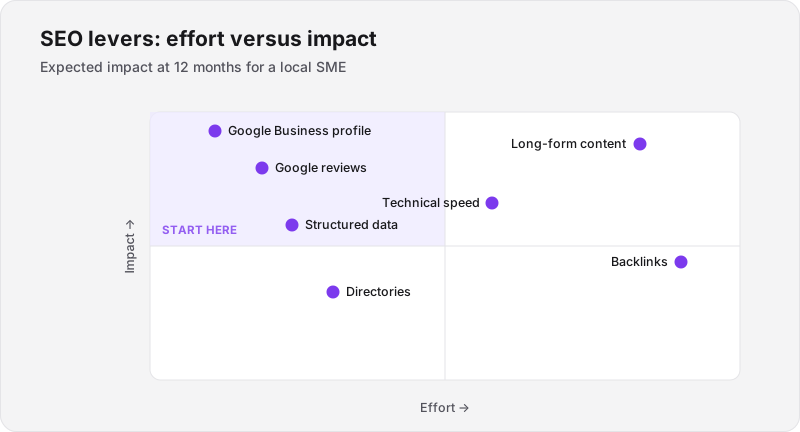
Top left is the best return for the least effort. That is where you start.
What content does Google reward in 2026?
Google introduced E-E-A-T (Experience, Expertise, Authoritativeness, Trust) as its framework for assessing content. It is not a directly computable score, but a set of signals Google interprets.
Experience: have you actually lived what you are writing about? An article on “how to choose an ERP for a Moroccan SME” written by someone who has deployed ERPs in Moroccan SMEs carries more weight than a generic piece about ERPs in general.
Expertise: the depth and precision of the content. A 200-word article on local SEO explains nothing. A 1,500-word article detailing the concrete steps, the common mistakes and the useful tools demonstrates real expertise.
Authoritativeness: do other quality sources talk about you? Press mentions, professional directories, testimonials from named clients, social profiles with a consistent history.
Trust: does your site carry the basic signals? Legal notice, privacy policy, clear contact information, authentic client reviews.
How does local SEO work for a Moroccan business?
Local SEO is the most accessible and least saturated ground for the vast majority of Moroccan SMEs. Here is why.
The Google Business Profile is lever number one. When someone searches “web agency Casablanca” or “Odoo developer Morocco”, it is the Business profiles that appear in the map results at the top of the page — above the classic websites. A complete profile (precise category, photos, opening hours, reviews, service area) can generate more qualified leads than ten blog posts.
NAP consistency (Name-Address-Phone) is critical. Your name, address and phone number must be identical on your site, your Google Business profile, your social profiles and your directory listings. Any inconsistency (a different number, a different spelling) dilutes your local authority.
Local pages: if you operate in several cities, creating dedicated pages (“web agency Casablanca”, “Odoo integration Rabat”) with content specific to each city improves ranking on geo-targeted queries.
Google reviews: the number of reviews, how recent they are and how you reply to them directly influence your ranking in local results. Five recent reviews are often worth more than fifty that are two years old.
What is GEO (Generative Engine Optimization)?
AI answers — Google AI Overview, Perplexity, ChatGPT — now cite sources directly inside their responses. For a business, being cited in those answers can generate as much qualified traffic as a classic first-page ranking.
The signals that encourage citation by AI systems:
- Self-contained passages: paragraphs that fully answer a specific question without requiring the whole article
- Density of verifiable facts: figures, studies, named examples — AI systems prefer sources they can check
- Third-party mentions: when other sites (directories, press, professional networks) describe your business the same way you describe yourself, that consistency strengthens AI trust
- Multimodal content: captioned images, tables, structured lists — formats that make information easy to extract
SEO levers compared by effort and impact
| Lever | Effort | Impact at 3 months | Impact at 12 months |
|---|---|---|---|
| Complete Google Business profile | Low | High | High |
| Technical speed (Core Web Vitals) | Medium | Medium | High |
| Long-form content (1,000+ words) | High | Low | High |
| Structured data (JSON-LD) | Low | Medium | High |
| Google reviews | Low | High | High |
| Professional directories | Low | Medium | Medium |
| Quality backlinks | High | Low | High |
Where do you actually start?
The most common mistake: trying to do everything at once and finishing nothing properly.
Step 1 — Audit what exists. What is your site's speed score (PageSpeed Insights)? Are you in the right keyword bracket (Google Search Console)? Do you have blocking technical issues (Search Console → Coverage)? Without that diagnosis, you are working blind.
Step 2 — Fix the technical base. If your site takes 6 seconds to load on mobile, no content will compensate. Technical first.
Step 3 — Create or optimise the Google Business profile. For a local business, it is the task with the best effort-to-impact ratio in the short term.
Step 4 — Publish useful content regularly. Not daily — regularly. One quality article a month is worth infinitely more than five 200-word posts a week.
Step 5 — Collect reviews. Send the Google link to satisfied clients right after delivery, not six months later.
How does Nexa Code Agency build SEO into its projects?
We build SEO in from the design stage, not as a final add-on. Concretely that means:
- A URL architecture designed for SEO from the design phase
- Structured data (JSON-LD) generated automatically for every page
- An XML sitemap submitted to Google Search Console at launch
- Core Web Vitals checked before every deployment
- A Google Search Console training session included in every delivery
For clients who want to go further, our digital marketing service offers ongoing SEO support: monthly audit, content, position tracking.
Technical details in our custom web service and our SEO service.
Frequently asked questions
How long does it take to see SEO results? The rule of thumb: 3 to 6 months for the first signals on long-tail queries, 6 to 12 months for competitive keywords. Local SEO (Google Business profile) can produce results in 4 to 6 weeks if the profile is complete.
Does local SEO really work in Morocco? Yes, and the market is barely saturated in most local niches. Many Moroccan businesses have no complete Google Business profile, or no reviews at all. That is a real opportunity.
Do you need a blog to do SEO? A blog helps, but it is not mandatory. Well-written service pages, case studies and local pages can generate as much traffic as an active blog if the content is good.
Does Google penalise AI-generated content? Google does not penalise AI as such, but it does penalise poor, generic or misleading content. AI content that has been reviewed, enriched with real data and adapted to a specific audience can rank perfectly well.
What should you measure first to track SEO progress? In this order: impressions and clicks in Google Search Console (real traffic), average position on target keywords, Core Web Vitals (performance), and number of Google reviews.
We work with SMEs across Morocco, including in Mohammedia, Casablanca and Rabat.